

A2P2 PLATFORM
The product is live
A2P2 is now a protected working environment for mechanism-driven product-lifetime decisions.
LIVEEnterprise access at a2p2.gulsineltd.com
On this pageFour stepsAgeing calculatorDemonstration
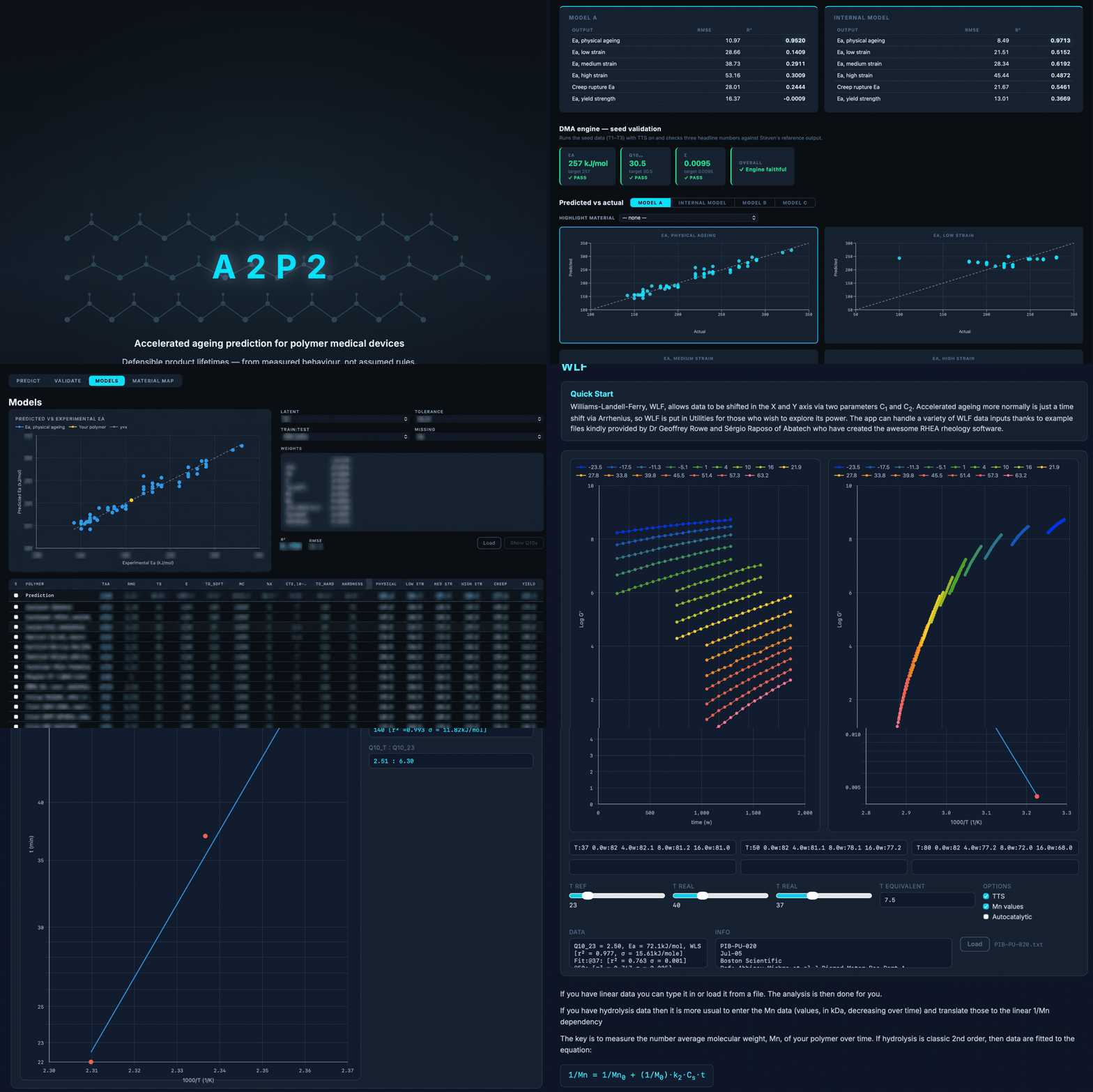
This public walkthrough uses representative information only. No client data or proprietary study output is displayed.
A2P2 WORKFLOW
Four steps to a defensible decision.
- 01Define the system
- 02Identify the governing behaviour
- 03Calculate time equivalence
- 04Generate the decision record
Accelerated ageing calculator
How many days in the oven does your claim really need?
Q10 = 2 is a convention, not a property of your material, and there is no universal value. Enter your claim and conditions to see what the default gives you, and what your material needs.
months
°C
°C
Default Q10 = 2
–
Your material
–
Why there is no universal Q10
Every material, and every degradation process in it, has its own activation energy. Q10 = 2 agrees with Arrhenius at only one of them: about 56 kJ/mol between 25 and 55 °C. Below that, the default under-ages the sample; above it, the sample is aged beyond its claim.
This is a patient-safety question as much as a leachables one. In our testing of implantable materials we have measured Q10 values below 2. Aged with the default, an implant can pass its end-of-shelf-life tests while being months younger than the device a patient receives.
Calculation only. Acceleration factor AAF = Q10(Toven − Tstorage)/10, the form used in ASTM F1980, or from Arrhenius when you enter an activation energy (Ea). Oven days = claim ÷ AAF, with 1 month = 30.44 days. It assumes one degradation mechanism and no thermal transition between storage and oven temperature. A2P2 predicts the activation energy of each material before anything is aged.
Discuss your materials
PUBLIC DEMONSTRATION — REPRESENTATIVE DATA
The architecture, demonstrated
1
Define the system
Example: gamma-sterilised polymer assembly with an adhesive interface.
Select the material, processing history, sterilisation route, ageing temperature and target claim.
2
Identify the governing behaviour
A2P2 evaluates the material or interface using the relevant workflow — creep, hydrolysis, oxidation, spectroscopy, thermal analysis or device-level Q₁₀.
3
Calculate time equivalence
Values shown in a client implementation are calculated from the organisation's experimental evidence; they are not taken from a universal default.
4
Generate the decision record
The workflow connects assumptions, source data, calculations, acceptance criteria and limitations into a traceable output for scientific, quality and regulatory review.
A2P2 becomes the licensee's internal capability.
Each completed study strengthens its governed materials library and the decisions that follow.
PUBLIC DEMONSTRATION
Reveals the architecture
This page shows how the workflow is structured, using representative information only.
RESERVED FOR LICENCE HOLDERS
Not the protected intelligence
The complete A2P2 framework, decision logic and selected briefings.
BRING A2P2 INSIDE YOUR ORGANISATION